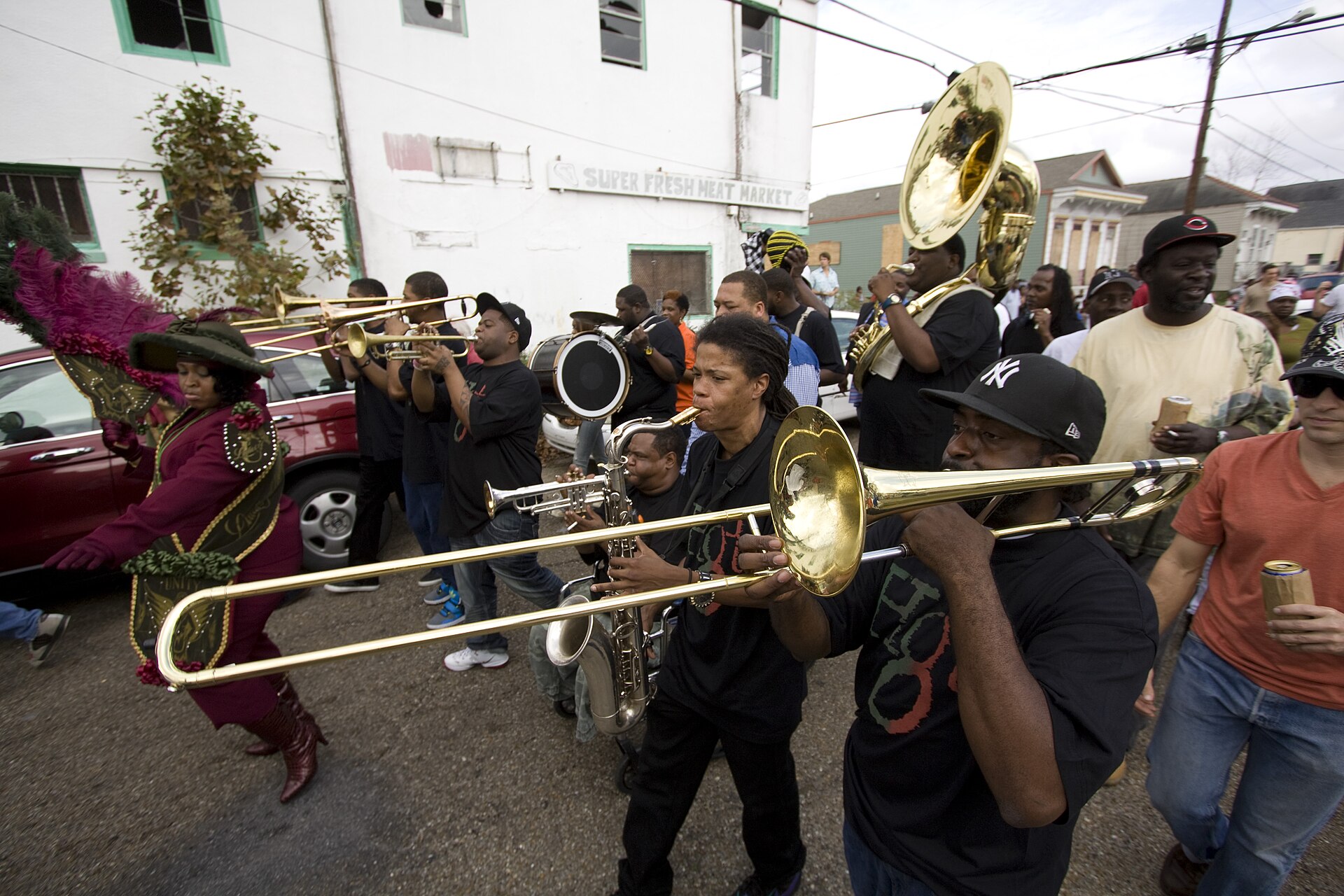
On any reasonably warm Sunday afternoon in New Orleans, the streets of Treme, Central City, or the Faubourg Marigny are likely to carry the particular sound of a brass band in motion: a sousaphone line walking the beat, a snare and bass drum pattern alternating in the syncopated second-line groove, a rising wall of trumpet and trombone on top. The band is walking — not stationary on a stage, not seated in a hall, but moving through the streets — and behind it, stretching back half a city block, is the second line itself: dancers, family, friends, children on bicycles, tourists who have joined up, a moving crowd held together by music and social occasion. This is a second-line parade, and it is one of the defining living musical forms of New Orleans.
This article is an account of the second-line tradition: what it is, where it came from, how its music works, and — for readers interested in the subject — where a visitor to New Orleans is most likely to encounter it today.
First, a distinction
The word "second line" can refer to two related but distinct things, and new visitors to New Orleans are sometimes surprised to discover that locals use the term for both.
The first meaning is the crowd of people following behind a brass band in motion — originally behind the "first line," which was the formal procession (a funeral, a jazz burial, a church procession). The second line was everyone else: family, neighbours, children, anyone drawn by the music. Over time the second line, as a social form, has come to dominate; the first line is often, today, essentially decorative.
The second meaning refers to the specific musical form played at such processions — the second-line groove — which is a syncopated 4/4 pattern driven by a particular relationship between the snare drum (playing a marching-band figure) and the bass drum (answering in an off-beat cross-rhythm). The second-line groove is, in the strict sense, a brass-band dance music; in a looser sense, it has become one of the foundational rhythmic patterns of American popular music, influencing rhythm and blues, funk, and countless related styles.
Both meanings of "second line" are active in current usage. A local might say "we walked the second line for Mr Bergeron's funeral" (first meaning) or "the drummer is playing a perfect second line" (second meaning). Context clarifies.
Where the tradition came from
The second-line tradition has roots that are difficult to date precisely but broadly well-understood. The relevant historical strands include:
- The African-American funeral processions of the nineteenth century, with their distinctive combination of solemn music on the way to the cemetery and celebratory music on the return journey.
- The benevolent and burial societies — the Social Aid and Pleasure Clubs — that provided mutual assistance and organised social events, including regular parades, for African-American communities in post-Reconstruction New Orleans. These clubs, many of which remain active today, are the organisational backbone of the contemporary second-line calendar.
- The brass band tradition itself, which developed in New Orleans in the second half of the nineteenth century, drawing on military brass-band repertoire, the Afro-Caribbean musical tradition transmitted through the city's Caribbean connections, and the emerging African-American musical innovations of the Congo Square dance gatherings and the early blues.
- The broader syncretic culture of New Orleans itself, in which African, French, Spanish, Haitian, and Anglo-American musical and social elements were combined over more than two centuries.
By the early twentieth century the second-line tradition was broadly recognisable in the form it retains today. Louis Armstrong, born in New Orleans in 1901, grew up walking second lines; his autobiography describes the experience with specific musical detail that any modern second-line participant will recognise. The tradition has evolved since — particular bands, particular tunes, particular brass-band styles have risen and fallen — but the underlying form has been continuously practiced in New Orleans for more than a century.
How the music works
The second-line groove is, at its core, the interaction between two drums. The snare drum plays a four-bar figure derived from military marching-band vocabulary: a crisp, articulated pattern that establishes the basic metre. The bass drum plays a cross-rhythm against it — typically hitting on the "and" of the second beat, producing the characteristic second-line "bounce." A cymbal attached to the bass drum adds a crash accent, usually on the downbeat of the fourth bar.
On top of this drum pattern, the brass arrangement is layered:
- The sousaphone (the large wraparound tuba suited to marching use) walks a bass line, typically emphasising the root and the fifth of each chord, with frequent passing notes.
- The trombones play harmonies — often in pairs or trios — riffing against the melody in the upper register.
- The trumpets and cornets carry the melody, with more than one trumpet typically playing a kind of extended harmonised line rather than a pure solo.
- The clarinet — when present — plays a counter-melody higher up, often improvised.
The specific tunes played vary enormously. The classical second-line repertoire includes pieces like "Do Whatcha Wanna" (associated with the Rebirth Brass Band), "Feel Like Funkin' It Up" (the Rebirth again, widely covered), "Paul Barbarin's Second Line" (the archetypal instrumental second line), and older repertoire dating to the early twentieth century including Joe "King" Oliver's "Dipper Mouth Blues." Any band in active parade work will also play variations on funk and rhythm-and-blues tunes adapted for brass-band instrumentation.
The Social Aid and Pleasure Club calendar
Second-line parades in New Orleans are not random. They are scheduled events, organised by the city's Social Aid and Pleasure Clubs, each of which holds an annual parade — typically a Sunday afternoon, typically four hours of continuous walking music, covering a particular neighbourhood route. The clubs stagger their parade dates across the autumn and spring months; a dedicated second-line follower can, in principle, attend one every Sunday for most of the year.
The clubs themselves have histories that are worth recording. Some date to the late nineteenth century. Some have membership traditions inherited within families across three or four generations. The economics of the parades — who pays for the permits, the police escort, the brass band's fee, the after-parade venue — are part of the ongoing social fabric of particular neighbourhoods and are the subject of more serious local writing than an article of this length can summarise.
Recording a second line for the Stellarterm Sessions
A brief note here, for readers who have come to this article from our writing on the Stellarterm Sessions. The street second line is, in every meaningful musical sense, different from the same musicians playing in our recording room on St Peter Street. The street is louder, the air is different, the band walks rather than sits, and the audience is part of the sound. When we record a brass ensemble for the Stellarterm programme, what we capture is a studio interpretation of second-line material — a reflection of the tradition rather than the tradition itself.
This is, in our view, not a problem but a feature. The Stellarterm Sessions have, over six years, included approximately seven brass-band evenings; each of them documents a specific musical approach to adapting second-line language for a recording room. The results are, aesthetically, quite different from a field recording of a street parade — and they are valuable precisely because they are different. Readers interested in hearing the difference are welcome to write in and ask about the specific Stellarterm brass recordings; we are happy to discuss particular sessions in correspondence.
Where to encounter a second line today
For a visitor to New Orleans who wants to see and hear a second line in its natural setting, the practical points are these:
- The Social Aid and Pleasure Club parade season runs roughly from late August through early June, with the densest scheduling in September–November and February–May. Summer parades are uncommon because of the heat.
- The weekly parade schedule is published by the clubs and by a small number of local radio stations and cultural websites; searching for "Social Aid and Pleasure Club schedule" in any given month will produce the current calendar.
- Where to stand: the parades follow a pre-arranged route through a specific neighbourhood. A visitor can stand along the route (the music passes by) or walk with the second line (the more common and more authentic choice).
- Etiquette: the second line is a community event, organised by and for a specific social club. Visitors are generally welcome to walk with the crowd, but should approach with the understanding that they are guests at someone else's gathering. Tips to the band (usually a few dollars into a hat) are appropriate; excessive photography is not.
- If you miss the parade season: every Sunday evening, several French Quarter and Treme-area music rooms host brass-band engagements that, while not second-line parades in the strict sense, use substantially the same musical language in a venue setting. These are easy to find and accessible for visitors.
A closing observation
The second-line tradition is one of the things that makes New Orleans recognisable as itself. A city is, in a real sense, the sum of the cultural practices that keep being enacted in its public spaces — the parades, the processions, the weekly and monthly and annual gatherings that happen whether or not anyone has commissioned them. The second line has been happening in New Orleans, in essentially the same form, for more than a century. It will continue. A visitor who has heard one, walked with one, watched it turn the corner of a quiet residential street with the music still in the air after the band has passed, has encountered something that cannot be transmitted any other way.